The Secret Symbols of the Rosicrucians (Part 1)
[Die geheimen Figuren der Rosenkreuzer]
Franz Hartmann, M.D.[1]
Translation from the German by Robert Hütwohl
For Part II, click here.
This document incorporates live notes. Click on a superscripted endnote number in the text to jump to its corresponding endnote; click on the superscripted endnote numeral in the endnotes to return to the original text reference.
Translator’s note (Robert Hütwohl):
The “philosopher’s stone” in alchemical and Rosicrucian literature symbolizes a spiritually enlightened individual who has achieved self-knowledge and wisdom. This “stone” represents the union of the individual with their higher self, granting them immortality and the ability to transform their lower nature into higher virtues. The preparation of the philosopher’s stone involves the development of self-awareness and the creation of a transfigured, immortal body.
The philosopher’s stone, a central concept in Rosicrucian alchemy, symbolizes spiritual rebirth and the attainment of divine knowledge. It is not a physical substance but a transformative process achieved through the union of will and thought, leading to the purification and exaltation of the soul. This process, depicted in alchemical symbols and imagery, involves the transcendence of earthly desires and the realization of one’s divine nature.
End.
The “Philosopher’s Stone.”
“If they had the philosophers’ stone,
The wise men lacked the stone.”
As is well known, the “philosopher’s stone” and its production played a major role in the literature of the alchemists and Rosicrucians of the Middle Ages. Through the magical power of this stone, it was believed that all base metals could be transformed into real gold and silver and all illnesses could be cured, even rejuvenated and death could be avoided indefinitely. It is not surprising, therefore, that a large number of chemical experimenters devoted their time and fortune in search of this wondrous stone, and that many became insane. Even today, the belief that there is a substance capable of turning lead, copper, tin, and other metals into gold has not died out, and there is evidence that such transformations are possible. Among other things, the imperial treasury in Vienna contains a large oval, a commemorative coin decorated with the images of the ancestors of the imperial family, which consists of two-thirds silver, while the remaining third was turned into pure gold by the Augustinian monk Wenzel Seiler, for which the monk was struck to the “Knight of Reinburg” by Emperor Leopold I.
That it may be possible to transform one metal into another, and that modern chemistry is on the way to discovering it, will scarcely be denied; but true alchemy has nothing to do with such chemical experiments; it is not primarily concerned with external objects, but with internal elements and forces, and if the alchemists of ancient and modern times have not succeeded in finding the philosopher’s stone, the reason for this is that they have dealt with it with external ones trying to produce means instead of preparing it in themselves. The philosopher’s stone, or in other words “the rock” upon which Christ built his church, is the born-again, fully conscious of his spiritual (occult) powers, perfect man.
The philosophers of the Middle Ages used certain symbols and language not easily understood by the uninitiated to protect the sacred mysteries of religion and “royal art” from profanation by the profane. The “philosopher’s stone” of which they spoke is the man who has attained true, divine self-knowledge, whose strength of character is unshakable and who is in possession of wisdom. By his standing in the power of true, living faith and knowledge of God (the Higher Self), he is enabled to unite his will with the Divine Will, and by its power the lower elements, desires, and passions inherent in his human nature and which the alchemists refer to in their symbols as “base metals” (copper, lead, tin, etc.) and to transform them into the “gold” of high wisdom and the “silver” of noble thoughts.
Wisdom is the true knowledge of the truth, the realization of the ideal, the knowledge of the higher self, which man does not achieve through objective observation, but only through his own becoming. It is consequently the perfect union of the knower with the object of knowledge in the power of knowledge. This is symbolized by the triangle, since it consists of three intimately connected sides, which together form a unity, a whole that cannot be separated. In the perfect man this union of spirit man with his higher self has taken place in the power of self-knowledge; therefore he is not only in possession of the philosopher’s stone, because he himself is this stone.
This “stone,” or more clearly, this being, is the panacea against all evils, for through union with his higher being man attains exaltation over all that is his lower nature and his; mortal shell is concerned. By possessing this stone, man attains immortality. Not that his visible body would thereby become immortal; because this is only the shadow of his true self, only its earthly clothing; but the inner man attains knowledge of his higher existence on this path; the consciousness of his individual immortality in the higher being awakens in him.
By means of this royal art of preparing the philosopher’s stone, man constructs for himself the transfigured astral body, which he then possesses both during his life on earth and after he sheds his mortal body. The soul or ego of the human being who has awakened to true self-awareness is not an insubstantial nothing, or like a bubble that crumbles when it bursts. There are certainly many so-called “herd people” who have not yet come to their own thinking and the intellectual realization of their individuality, who do not have a pronounced individual character, but are only playthings of the thinking and feeling of others, whose aspirations do not go beyond the horizon of their personal desires and Desires go beyond and which cannot rise above the general public, but are governed by the prevailing instincts and ideas. Such people, although they differ physically and as personalities from others like them, may well be regarded as “class souls” who do not yet have their own soul, that is, one that has not awakened to true self-awareness. The preparation of the philosopher’s stone consists in the development and strengthening of higher self-awareness, through which man attains knowledge of his individual being on a higher, spiritual level. In the process, his spiritual rebirth takes place in him and he builds up the transfigured body of immortality, of which the apostle Paul says that its seed was sown in the perishable body and that from this the imperishable body came into being.
This “etheric” body is also often mentioned in Indian philosophy, it is described by Patañjali as imperishable, indestructible, transfigured and luminous, and it is taught that while in an ordinary gregarious man this etheric body dissipates after death like a cloud, in a spiritually exalted man it forms the material from which the body of immortality arises. Nor does this appear incomprehensible when one considers that basically all is essentially One, and what we call “matter, “ether,” “spirit,” etc., are merely various manifestations of the nameless One, and are, as it were, different vibrations of the forces springing from the One.
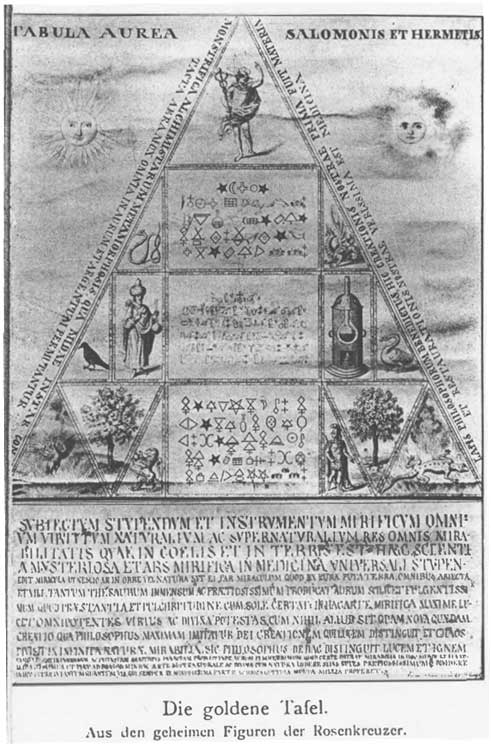
Among the “Secret Figures of the Rosicrucians” of the 16th and 17th centuries is a most rare tablet on which the preparation of the Philosopher’s Stone is symbolic but clearly and distinctly depicted to the experienced alchemist.[2]
The figure represents a triangle illuminated by the sun and the moon, in which the alchemical processes are symbolically indicated, and the inscription below gives us information about the meaning of this work. [It is, in Latin]:
Subjectum stupendum et instrumentum mirificum omnium virtutem naturalium ac supernaturalium. Haec scientia mysteriosa et ars mirifica in medicina universal stupen edit miracula, ut nescio an in orba vel natura sit ei par miraculum, quod ex pura puta terra, omnibus objecta et vili, tantum thesaurum immensum ac praeciosissimum producataurum scilicet fulgentissimum, quod praestantia et pulchritudine cum sole certat: In haec arte mirifica maxima lucet omnipotentes virtus ac divina potestas, cum nihil aliud sit quam nova quaedam creatio qua philosophus maximam imitatur Dei creationem, qui lucem distinguit et chaos divisit in infinita natura mirabilia, sic philosophus de hac distinguit lucem et ignum eamque dividit in inmensane ac infinitum sanitatis panaceam, producit inde aurum pulcherrimum quod certe patrat mirabilia in hoc mundo et ita voluit altissimus ut fiat ad donum. Si in hac arte supernale ac divina cum natura ludere scias potes preciosissimum dividere in hoc opere in tantum quantum vis, qui semper ex minutissima parte ac unica guttula multa millia proferet.
Into English:
The amazing subject and the marvelous power of all natural and supernatural instruments. This mysterious science and the wonderful art of universal medicine produce astonishing miracles, so that I do not know whether the bereaved or natural wonder is equal to it that from pure earth, for instance, to all objects and cheap things, it will produce such an immense and most precious treasure, namely, the most brilliant, which competes with the sun for excellence and beauty. He imitates the greatest creation of God, who distinguishes light and chaos divides wonders into infinite nature. Thus the philosopher distinguishes light and fire from this and separates it into an immense and infinite panacea of health. to make a gift. If you know how to play with nature in this supernatural and divine art, you can divide up the most precious thing in this work as much as you want, which will always produce tens of thousands from the smallest and only one drop.
The headings on the sides of the triangle read:
Lapis philosophorum benedictus, hic creationis nostrae prima fuit materia et restaurationis nostrae verissima est medicina.
Monstrifica alchemistarum metamorphosis, qua midae instar contacta aera mox omnia in aurum et argentum permutantur.
Into English:
Blessed is the stone of the philosophers, this was the primary matter of our creation and is the truest medicine for our restoration.
The metamorphosis freaks alchemists by which the air, like Midas, having been infected, soon all things are changed into gold and silver.
From these communications it appears that the preparation of the philosopher’s stone is a mysterious science and divine art, from which arise marvelous things unparalleled in either heaven or earth, and that out of the common and despised earth (matter) a immeasurable and most precious treasure is produced, the shining gold, whose splendor and beauty is comparable to the sun. As at the beginning God saw the light and separated it from the darkness of chaos,[3] so the enlightened alchemist discerns the (spiritual) light and heavenly fire, and separates the light from the dark (Buddhi-Manas from Kāma Manas). Anyone who understands this supernatural (spiritual) art can divide the treasure they have gained into as many parts as they wish, because even the smallest part and the single drop of this universal medicine will result in many thousands of fruits.
“The blessed philosopher’s stone is the universal medicine which effects the restoration of our original divine state; his touch instantly turns everything to gold and silver.”
The writings of all the other Rosicrucians also show that we are not talking about the manufacture of ordinary gold and silver, but about something far more important. So, for example, says the unnamed author of the “Golden Fleece”:
“It is given to the body in time
The spirit which delights the soul.
When the spirit draws the soul to him,
And since none deviates from the other,
So all three stay together
Until the body is dissolved free,
Faults and dies, separates from him
soul and spirit, but according to time
It all comes in the last heat
Reunited and retains his seat
All in right perfection Glorified with great joy.”
This is the spiritual rebirth, the resurrection of the immortal body in the corruptible body of man who has come to true self-knowledge through mystical death. No external equipment is necessary for this: Because it is taught:
“Whoever persists in the fear of God,
Also in his word do practice,
And diligently waits for his job,
Nothing can go wrong black or white,
That same person cannot go alone
be of tin, steel, iron, and copper,
gold and silver are enough for him
But he can still go to the things
In advance, if God is kind to him,
Make gold out of hard stone-clay.”[4]
Certainly all kinds of ovens, retorts and the like are mentioned in the books of the Rosicrucians; but this was for the purpose of veiling the great religious mysteries from the eyes of the greedy. That is why Paracelsus writes openly:
“What is there to say about the many recipes, and the various vessels, ovens, glasses, shards, water, oils, salts, sulphur, etc. You have to put it all away and leave it there; for it does not work for the five metals to make gold and silver.”[5]
The Rosicrucian symbols have at least twofold meaning. When the “Sun” is mentioned, it means not only our visible sun, the giver of all life in our universe, but also the spiritual sun of the world, the source of wisdom, love and life of the soul,[6] and below the “moon” is not only understood as the light of night in the visible sky, but it is also the symbol of thought, of creative imagination. The sun signifies the spirit, the moon means matter, the sun the procreative will, the moon the formative power of nature. From the union of will and thought (“man” and “woman”) the “son” arises, the deed.
In the accompanying figure, the large triangle illuminated by the sun and moon means man. He is a three-dimensional being and represents a world in miniature (microcosm) in which all the forces of the big world (macrocosm), whether active or latent, are contained. If he knew all the occult powers still dormant in him, awakened them within himself and used them properly, he would be godlike and perfect. He is a child of sun and moon; (Schopenhauer calls it “will and imagination”) in him body and soul are connected, but the spirit is unbound and free; that is why the non-enlightened person still has little power over his thinking and very few people have the strength to hold on to a thought; most do not think for themselves, but are the playthings of ideas “floating in the air” and dominated by thoughts which come from outside influences. That is why ordinary man is compared to a reed swayed by the wind, and man born again in the Spirit of God (in the realm of true knowledge) as the philosopher’s stone, or can be the rock unshakeable by the waves of the stormy sea of life. This steadfastness, this “steadiness in spirit,” can be attained through the union of will and thought in the word, or rather in its power; “For the kingdom of God is not in words, but in power.”[7]
A glance at the Tabula aurea now reveals three squares, one above the other, ending in a triangle containing a human figure representing Hermes. These squares represent the four states or planes of human existence, namely the outer world of senses, the inner life or “astral plane” and the spiritual world. We are placed in this material world where there is light and dark, good and evil, and before us is the “tree of knowledge” bearing good and bad fruits (karma).[8] On the left side of the picture is drawn the phoenix, the symbol of the higher aspirations of the soul, rising from the flames of earthly desires and striving for heaven, and the lion, the symbol of willpower. On the right side we find man on his way to the tree: knowledge. He is depicted as a victorious hero bidding farewell to the temptations of the sensual world and looking back with contempt on its delights. He transcends his animal nature, represented by the salamander dying in the fire of the love of God. The alchemical signs contained in the three squares represent the physical, ethereal, astral and spiritual elements, principles and forces contained in human nature, which the alchemist knows how to use to accomplish the great work of transforming and ennobling himself. Just as chemical compounds are dissolved and connected to others in a chemical process, the impure is separated and the pure is obtained, so it is in alchemy with the spiritual elements; there is dissolved the fire of love 🜂 permeates the water of thought ▽ and the material, the “earth” 🜁; the spiritual ☊ rises and the purified, “the scent of the white lily” descends again to earth as a blessing for mankind.[9]
In the next field on the left we find the alchemist at work; he holds the flask in his hand, determined to complete the work. But this cannot be done by external means, and so on the right side of the picture the alchemist is represented as the furnace, which is himself. In him, and not outside of him, is the purification and exaltation; in him is the flame of love, which creates the moderate warmth needed for work. The “black raven,” the symbol of the earthly and impure, is removed and in its place comes the “white swan,” the symbol of the soul in its purity, swimming on the stormy sea of life, full of confidence and conscious of its security, that he cannot perish; for the Blessed One does not sin.
The top square represents the spiritual plane. The serpent of lust for earthly possessions disappears and the dragon of passion is vanquished; the alchemist is no longer depicted here; for he has died a mystical death and is no longer relevant as a personality.[10] The “two birds,” matter and spirit, the individual and the divine consciousness have merged, the human and the divine will are only us; personal thinking has merged into the idea of God and the heavenly marriage of spirit and soul has been accomplished.[11]
Thus the magnum opus, the great work, the completion of which takes hundreds of thousands of years and countless reincarnations, but can also be completed in a moment, even succeeded “by a woman sitting at the spinning wheel,” and the philosopher’s stone is found. This is represented symbolically by the uppermost triangle. Here the three have become one; the knower is no longer a being distinct from the deity, the object of intuition, but is united with the deity through the power of the knowledge of God. God and man are one; the soul is illuminated by the light of wisdom; the divine self knows itself, not by any concrete intuition or philosophical speculation, but because it is itself the Self and, the illusion of peculiarity and separateness from the sole having vanished, recognizes itself in spirit and in truth as the sole Self of all recognizes beings. In this realization of the divine ideal in man consists the “philosopher’s stone,” the Adeptship and the universal medicine, which cures all ills, for all ills in the world have their cause in ignorance of the higher existence, and through its knowledge the cause of all ills is removed.
Notes:
[1] The Secret Symbols of the Rosicrucians. (Part 1) [Die geheimen Figuren der Rosenkreuzer. Franz Hartmann, M.D. Neue Lotusblüten 4, no. 1-2 (January-February 1911), 1-16] {This article was reformatted from the original, but with the content unchanged other than fixing minor typos. Translation from the German by Robert Hutwohl, ©2025}
[2] See above [Beginning of this article.]
[3] Nuremberg 1737.
[4] Compare I Corinthians 3:11 & 12.
[5] “Liber Vexationum,” page 387.
[6] John 1. 4.
[7] I. Corinthians. IV. 20.
[8] I. Moses II. 9.
[9] An entire book would be required for an explanation of all the alchemical symbols.
[10] Colossus I. 27.
[11] I John III 9.