Pontifex Maximus. By Brother∴ Dr. Franz Hartmann, 33.º, 95.º.
Dr. Franz Hartmann[1]
Translation from the German black-letter by Robert Hutwohl
“Freemasonry and the Catholic Church both use the metaphor of a “bridge” to represent the connection between the higher, divine part of the soul and the lower, material part. This bridge, known as the “Antahkarana” in Indian philosophy, must be built and crossed within oneself to achieve spiritual enlightenment and immortality. The ability to cross this bridge during life determines one’s fate after death, liberating them from sensuality and error.” Robert Hutwohl
This document incorporates live notes. Click on a superscripted endnote number in the text to jump to its corresponding endnote; click on the superscripted endnote numeral in the endnotes to return to the original text reference.
In the higher degrees of Freemasonry, frequent reference is made to a “crossing of the bridge,” and in the Catholic Church, the Pope is called “Pontifex Maximus”—that is, the Supreme Bridge-Builder. Since neither the Freemasons nor the Pope concern themselves with the construction of visible bridges, it is clear that a hidden meaning underlies these designations; and it is all the more important to discern this meaning, inasmuch as our entry—through the Triumphal Arch (Royal Arch)—into the Temple of Wisdom depends upon our own “bridge-building” and “crossing of the bridge.”
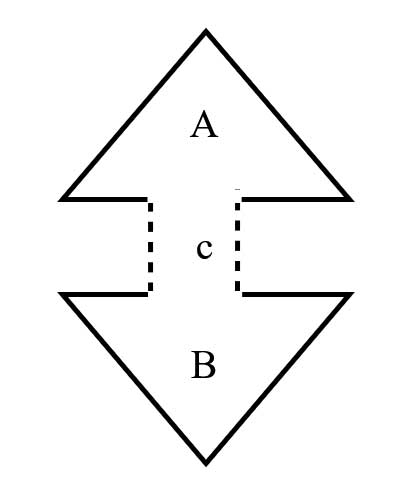
We need rely neither upon the teachings of Indian sages nor upon those of Christian mystics, but need only look within ourselves to know that two regions of the soul—or forms of consciousness—exist within us: The higher of these strives toward the lofty and the ideal, while the lower is bound to the material and drawn toward the sensual. Anyone who has ever wrestled with themselves and overcome their own nature recognizes this duality within the human constitution—the struggle between the higher, immortal Self and the transient, personal ego. Goethe describes this state in “Faust” with the words:
“Two souls, alas! dwell in my breast;
The one seeks to part from the other”— and so on.
The one, divine part of the soul is born of the light of knowledge; the other, mortal part is the product of nature. The upper, celestial part strives toward its home—Heaven—while the other gravitates toward its origin—the Earth (matter); both may be compared to the two poles of a magnet, each of which exerts an attraction opposite to that of the other.
In Indian philosophy, we find this doctrine expounded in a systematic manner. Manas (the mind, or “mens”) is twofold. As indicated in the figure above, a distinction is drawn within it between: A—the upper, luminous part, “Buddhi-Manas”, or the enlightened aspect of the soul, wherein dwells the light of true knowledge; and B—the lower, darker part, “Kama-Manas” [kāma-manas], the seat of selfish desires and animal instincts. The part designated by “c” represents the ideal bridge—a bridge that every true Freemason must build, fortify, and cross within himself if he wishes to pass from the realm of the passions (“Kama” [kāma]) into the realm of Light (“Buddhi”). In Sanskrit, this bridge is called “Antahkarana” [antaḥkaraṇa]; it is the principle that unites God with man—the Immortal with the mortal within the human being—and whoever crosses it passes through the Gate of Immortality. In Indian philosophy, we find this doctrine expounded in a systematic manner.
Occult science teaches that, after death, a separation takes place between the two regions of the soul. A cleavage of self-consciousness occurs—such as we frequently perceive in dreams. The higher, spiritual Self returns to its true home; the lower, illusory self may continue to exist in the underworld for a shorter or longer period, until it finally disintegrates as a larva or “shadow.” The ancient Latins, too, were acquainted with these teachings—which remain largely unknown to our modern psychologists and theologians—and of which Lucretius[ii] says:
“There are two parts of man: ghosts, flesh, spirit, shadow;
These four places receive two parts.
Earth drives flesh, shadow flies over the grave,
Hell has its manas, spirit seeks the stars”
Whether, therefore, we can enter into a state of blessedness after our death depends on our “crossing of the bridge” during our lifetime. Through this, we are liberated from the “Babylonian Captivity”—that is, from sensuality and error.
Space does not permit us to delve deeper into this aspect of occult Freemasonry, but the foregoing suffices to draw attention to the fact that every Freemason is destined to become a Pontifex.
Notes:
[1] Pontifex Maximus. By Brother ∴ Dr. Franz Hartmann. Oriflamme 2, no. 6 (June 1903), 50-52. [Translation from the black-letter German by Robert Hutwohl, ©2026]
[2] [R. H.—Titus Lucretius Carus, Roman poet and philosopher (circa 99 – October 15, 55 b.c.)]